Episode 4: Geeking Out at the Bay Model
- Apr 3
- 3 min read
Updated: Jun 10
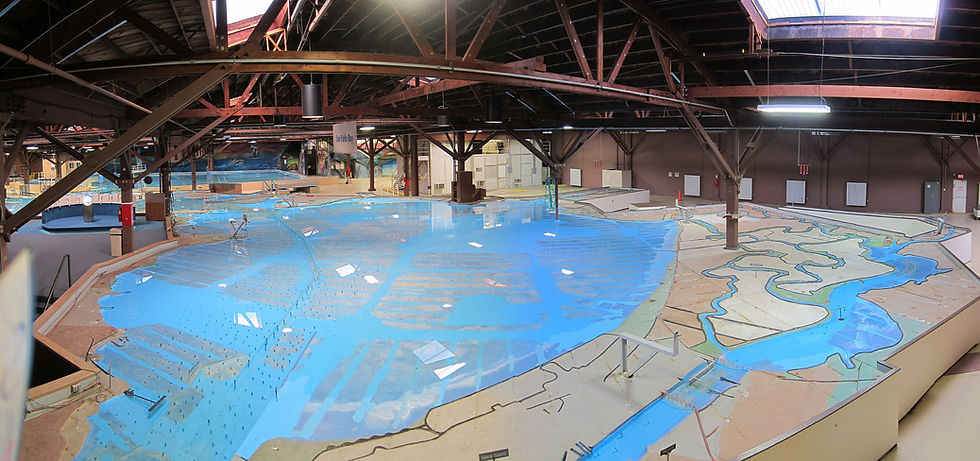
Back in 2024, Mike and I spent a day with the U.S. Army Corps of Engineers in Sausalito. First at the gigantic working hydraulic Bay Model, with Park Ranger Linda Holm, and then with the Hazard Removal division, which operates the Dillard and Raccoon debris collecting boats. It was a fantastic day and we met some committed Bay heroes, but first I just have to say one thing.
Holy shit the Reber Plan.
The Reber Plan

This scheme, first dreamed up in the late 1920s by a theatrical producer named John Reber, would have dammed off San Pablo Bay and the South Bay to create two giant freshwater lakes. It would have filled 20,000 acres of salt water & wetlands and turned what was left of the Bay into a "defensible military installation." Richardson Bay, half paved over, would have become a torpedo base. Corte Madera & Larkspur, completely filled in, a submarine base. Berkeley, Oakland, Alameda... a naval base and industrial park. The southern dam, just below the Bay Bridge, was to carry a 32-lane highway plus two rail lines. That's not a typo: 32 lanes of traffic.
Point San Pablo to Point Pinole was to be filled completely, creating an airport and industrial park bisected by a huge shipping canal. The marina we're floating in right now would be under tarmac.This insane plan garnered plenty of political support and was tinkered with for decades. Finally in 1950, Congress authorized $2.5 million to the Army Corps of Engineers to do a definitive comprehensive study - and thus was born the Bay Model. I think it's fair to say that this pre-computer model, housed in an old Liberty Ship facility in Sausalito, is the coolest hand-sculpted 1.5 acre 3-dimensional working hydraulic scale model of a water system ever built, and the only one left of its kind in the world, that is all.
The Reber Plan flunked its study on 99 discrete measures and was put to death in 1963.
The Bay Model

We happened upon the model on a morning when it had no water, as the pumps were undergoing maintenance. By midday, the water came back on and the basins slowly filled. This was a piece of luck for us. Seeing the Bay both empty and full really emphasized the disparity in contours between the shallow bays, with an average depth of 12 to 15 feet, the deeper channels, and the enormous scouring action that has dug under the Golden Gate Bridge to a depth of 372 feet.
We also got to see the copper tags in all their glory.

Engineering Runs in the Family
Not kidding here. As a responsible editor I had to leave out chunks of material that didn't fit story or time constraints but still feel oddball enough to record somewhere.
Like our father taking 3 kids with him to run torpedo tests in Key West. Or our grandfather explaining how mosquitos are essentially fighter planes. Or me dragging husbands all over the country to see empty reservoirs during droughts, or budgeting an entire day to tour the bowels of the Hoover Dam only to find out that one of my sisters did the exact same thing years earlier.
As I say, it runs in the family. Between them, our father, uncle, and grandfather designed torpedos, transformers, locomotives, Mack trucks, and the F-16 fighter jet. Dad's forebears put up water mills seemingly every time they crossed a stream in New England - one of them even brought his own millshaft along on his passage from England because he was wasn't sure about the quality of wood in the New World. We even have representation in the early days of the Army Corps of Engineers, when Peter Colt was tapped to replace Pierre L'Enfant in harnessing the Great Falls at Paterson, New Jersey. None of this is germane to the Bay Model story, except in explaining why I'm such a fan of engineers.


Comments