Episode 6: The Last Place Like This
Updated: Jun 11
Hidden behind Chevron's tank farm and built on the bones of condemned ships, Point San Pablo Harbor feels like a place that shouldn't exist. In this episode, we explore the history, characters, and unlikely revival of one of the last truly eccentric waterfront communities on San Francisco Bay.
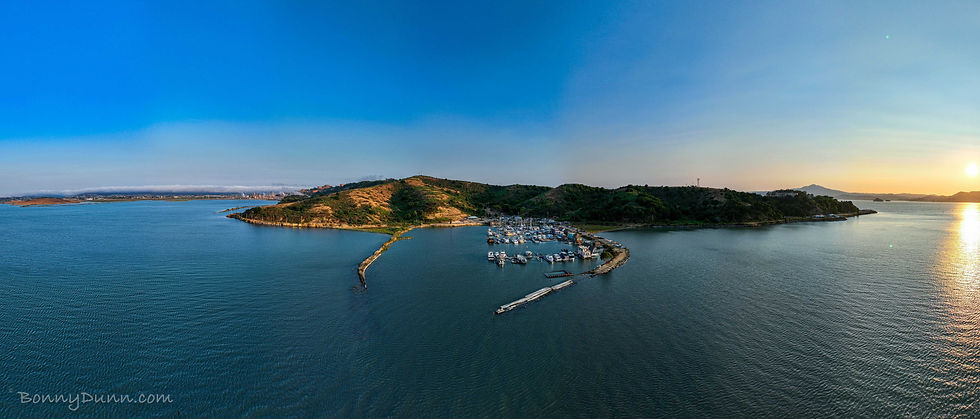
MAGIC TRICK: The harbor sits in the shadow of Chevron in the heart of the industrial Bay, but feels like it's in the middle of nowhere.

Captain Raymond Clarke
Clarke's son Alan recorded a fascinating oral history in 1984 which includes a lot of information about his father and the creation of Point San Pablo Harbor. It resides at UC Berkeley's Bancroft Library. We tried for 18 months to get permission to use the audio in our episode but could not break through the bureaucracy. Anyway, here's a link to the transcript.
Under the Breakwater
Google Earth images of Point San Pablo Harbor in 1939 and 2023.
Three lumber schooners buried in the breakwater: The Bertie M. Hanlon, the Siskiyou (pictured at left in the center photo), and the Jane Nettleton, which was nearly lost in a four-day1928 storm.
On the dangers of being a lumber schooner going in and out of doghole ports:
Close to 200 reported shipwrecks may line this section of the coast, the majority of them being lumber schooners lost while engaged in the trade on a shore described in the Coast Pilot of 1889 as being lined with jagged rocks above the water, sunken rocks, foul bottom and breakers… These wrecks form an important part of the maritime cultural landscape of the redwood coast.
An undated side view of the harbor. The Bertie M. Hanlon is the ship with the tall superstructure in the far jetty; the Siskiyou appears to be to the left of it. The ship directly across from the Hanlon is most likely the Jane Nettleton, which now lies under the jetty between the beach and Dock 6.
The hull on the beach, possibly a surplus World War II sub chaser.
A 1962 photo of Point San Pablo Harbor in decay; 3 years later the ships were burned to the waterline and covered with dirt bulldozed from the hills. The bow visible on the beach today is one of the two red circled vessels.

Blood Alley (1955)
BLOOD ALLEY is a terrible, racist, Red Scare period piece starring John Wayne & Lauren Bacall, whose on-screen chemistry approaches absolute zero. With Anita Ekberg as a Chinese villager, because why hire an actual Chinese person? This movie is highly not recommended, except for the scene filmed at Point San Pablo Harbor.
Here's a John Wayne monologue my son wrote for our parody episode and we regretfully had to cut for time. It's letter-perfect:
"Listen up, gang, 'cause this ain’t a democracy. We’re outta food and our steamer’s running on chopsticks but if we’re gonna paddle this duckboat all the way to Hong Kong we got a more immediate problem: Sinicized dialectical-materialism."

If you absolutely must, you can watch Blood Alley online for free. The part covering Point San Pablo Harbor runs from 1:30-1:52.
Meanwhile, here's Lauren Bacall climbing up the stern of the vessel we think is the one visible on the beach. If so, this stern lies under the jetty between Docks 2 and 3. The ship hasn't moved since the filming. The beach and wetlands were built up alongside it and the jetty over the top.
Lauren Bacall is running atop the ship toward the bow, trying to reach their stolen riverboat and escape the terrible Chinese bombs and gunfire exploding all around her. Tragically, she is too late. Thank goodness John Wayne comes back through gunfire to save her.
Music & Big Art
Today there's live music on the waterfront meadow, at the Y-Knot Club, and at the Sailing Goat. Visit the harbor website for details.
Big, public, surprising art is tucked all around the marina, many pieces inspired by Burning Man. The two pictured here are "Asterpod" by Michael Christian and "Niloticus" by Peter Hazel.


Comments